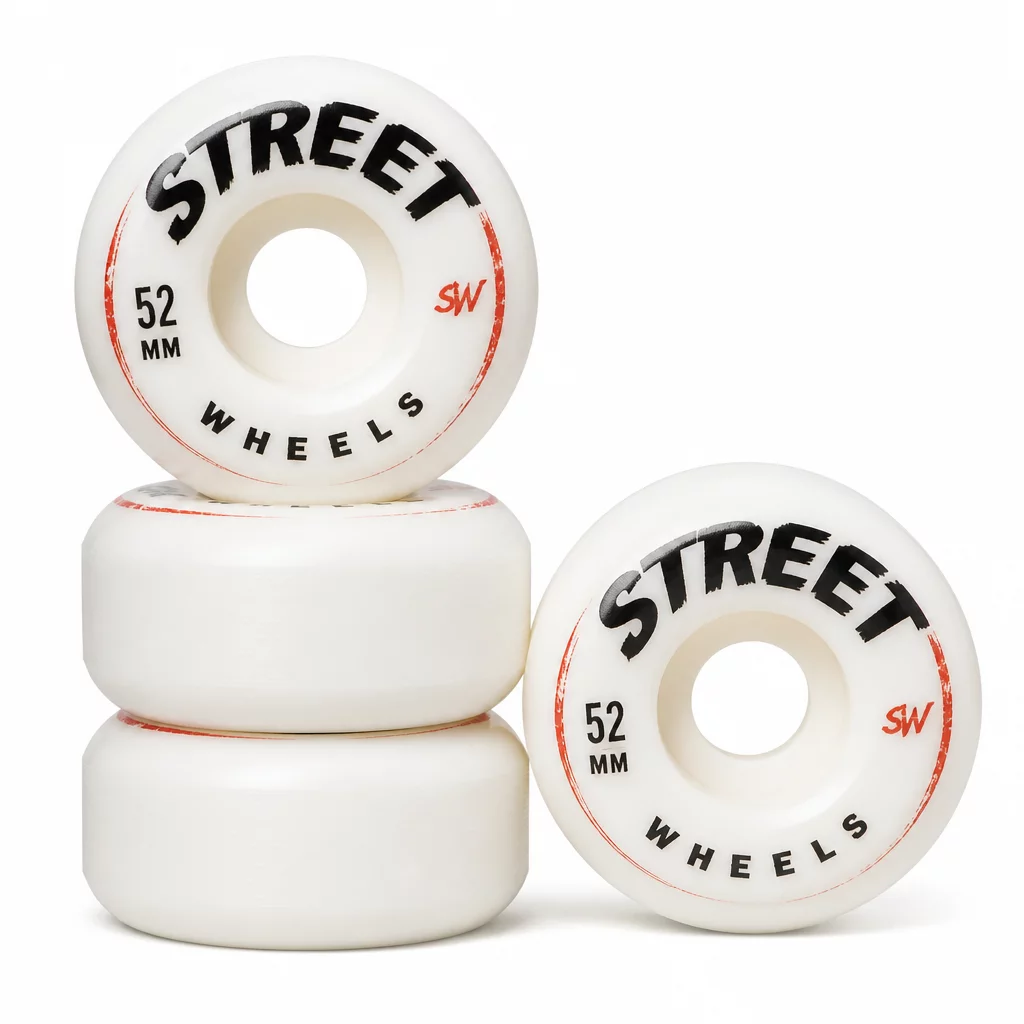
Why 52mm Represents the Core Standard for Technical Street Skaters
Street skaters consistently gravitate toward a 52mm diameter because this size establishes an ideal equilibrium between technical board control, acceleration speed, and a low center of gravity. Smaller wheels noticeably minimize overall setup weight, enabling skaters to snap cleaner ollies and rotate flip tricks faster on flat ground and concrete ledges. Because the clearance between deck and ground remains tight, pop angle responsiveness improves immediately without causing unexpected wheel bite on standard setups.
While larger cruiser wheels retain roll momentum across rugged street asphalt, 52mm wheels generate rapid bursts of acceleration in skateparks and plaza spots. The reduced rotational mass allows riders to regain speed instantly out of ledge slides, manuals, and technical transition maneuvers.
Polyurethane Formulation and Contact Patch Dynamics
Wheel compound hardness and contact profile determine friction levels, slide consistency, and resistance against flatspots during heavy street sessions:
- High-density 99A to 101A hardness ensures immediate slide release and prevents flatspots on harsh concrete ledges.
- Narrow contact patch minimizes rolling resistance across smooth skatepark surfaces for fast speed recovery.
- Symmetrical rounded lip profiles lock securely onto coping and square rails while providing predictable dismounts.
- Premium urethane rebound formulation absorbs micro-vibrations without losing mechanical rigidity during landings.
The 52mm wheel diameter remains the undisputed gold standard for technical street skating, offering unmatched agility, crisp pop feedback, and instant slide control on modern street spots.
Optimal Truck Sizing and Component Maintenance
Pair 52mm street wheels with low to mid-profile 139mm trucks and precision ABEC 7 or ABEC 9 bearings to eliminate the necessity for riser pads. Riders should rotate wheels in an X-pattern every three weeks to equalize urethane wear, preserving symmetrical contact geometry and preventing conical taper across intensive street riding months.
Community Discussion & Reviews
Verified CommunityNo comments yet. Be the first to leave a review!